When purchasing plywood for concrete formwork, unit price is usually the first figure considered. However, a comparison between plastic plywood and traditional plywood based only on purchase price may not reflect the real project cost. The number of successful reuses, waste rate and replacement frequency can significantly change the economics.
What Is Plastic Plywood Cost per Use?
Cost per use divides the total plastic plywood or traditional plywood cost by the number of successful concrete pours achieved with that plywood.
Simple formula:
Plywood cost per use = Plywood cost ÷ Succes..
Plastic plywood is a polymer-based plywood option developed for concrete formwork applications and repeated use. It performs the same basic function as traditional timber plywood by creating the contact surface for fresh concrete. Plastic plywood differs mainly in water resistance, surface stability and reuse potential.
Plywood used in concrete formwork should not be evaluated by purchase price alone. Moisture exposure, stripping damage, cleaning time and the number of successful reuses all affect the total plywood cost.
What Is Plastic Plywood?
Plastic plywood uses a polymer-based body inst..
How many times can plastic plywood be reused? There is no single fixed number. Plastic plywood reuse depends on the product structure as well as formwork design, concrete work, stripping method, cleaning, handling, storage and the number of holes made in the plywood.
Manufacturers may publish different plastic plywood reuse figures for different application conditions. It is therefore more useful to understand the factors that control plastic plywood service life rather than relying on one maximum number.
What Is a Plastic Plywood Reuse Cycle?
One plastic plywood reuse cycle includes install..
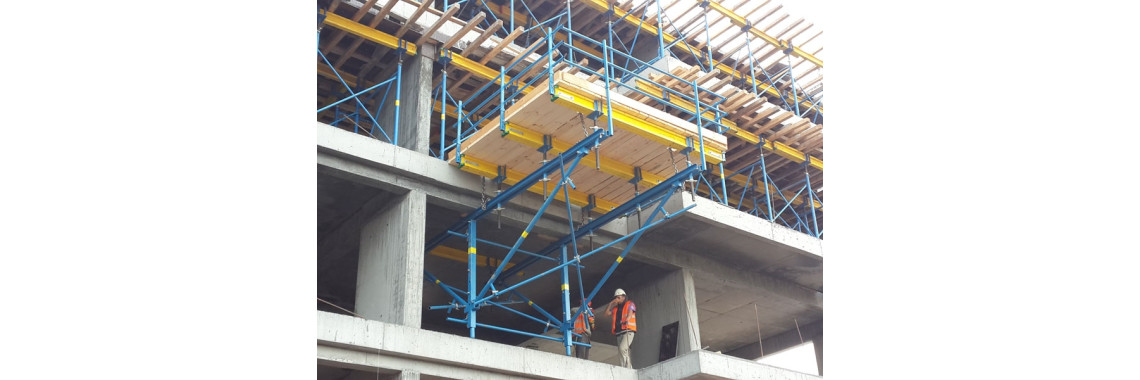
A construction loading platform or material handling platform is a jobsite platform used with a tower crane to receive or remove bricks, sand, cement and other heavy construction materials required during structural and finishing works at floor level.It can also support the transfer of dismantled table-shoring components after floor stripping. Components can be arranged in suitable stacked bundles or on pallets, moved onto the platform and lifted by tower crane to another floor or to ground level.The platform is not a hydraulic freight lift or scissor lift. It does not move vertically on its o..
A formwork tie rod, nut and bearing plate work as one connection assembly. The rod connects opposing formwork faces, the nut provides clamping and the plate spreads bearing force over a wider surface.
Tie Rod
The rod forms the tensile connection between opposing formwork faces. Thread compatibility with the nut is essential.
Tie-Rod Nut
The nut moves on the threaded rod and provides clamping. Outside nut diameter is only one product characteristic and does not by itself define allowable capacity.
See Ø70, Ø90 and Ø100 Tie-Rod Nuts.
Bearing Plate
The bearing plate helps distribute the nut f..
A formwork tie rod connects opposing formwork faces and helps maintain the intended spacing during concrete placement. Tie rods are commonly used in wall and column formwork.
Main Components
A tie-rod system can include the threaded rod, nut, bearing plate, sleeve, plug and special connection components depending on the formwork arrangement.
Rod, Nut and Bearing Plate
The rod forms the tensile connection, the nut provides clamping and the bearing plate spreads the bearing force over a larger surface.
See Tie Rod, Nut and Bearing Plate: How They Work.
Water-Stop Tie-Rod Details
Water-retain..
Ø70, Ø90 and Ø100 tie-rod nuts are different product classes identified by outside size. Outside diameter alone does not define allowable capacity.
What Changes Between the Sizes?
Outside dimensions and body geometry differ. Thread form, compatible rod and bearing arrangement must also be considered.
Does a Larger Nut Mean Higher Capacity?
Not automatically. Material, thread design, body geometry and the complete formwork connection determine performance.
Rod and Plate Compatibility
The nut must match the tie-rod thread and work with the intended bearing plate or support surface.
See Tie R..
In tanks, pools and other water-sensitive reinforced-concrete structures, the tie-rod passage can require a dedicated water-stop detail rather than a standard removable connection.
Water-Stop Tie-Rod Component
Water-stop components are used as part of special formwork tie details where water tightness is important.
Tie-Rod Pipe
A permanent tie-rod pipe can remain within the concrete and form part of the tie passage detail.
Tie-Rod Plug
Plugs are complementary elements used with tie-rod pipe systems. Standard and gasketed variants can be part of the product range.
Difference from a Standard..
T and L tie rods are special formwork connection components with different geometries from a standard straight threaded tie rod. They are used in specific multipurpose-panel and column-formwork connections.
T Tie Rod
The T-shaped component is used in designated panel connection points according to the formwork system.
L Tie Rod
The L-shaped component serves a different connection geometry. It should not be treated as automatically interchangeable with the T-shaped component.
Difference from a Straight Tie Rod
A standard straight tie rod forms a linear tensile connection between opposing for..
Scaffolding and formwork accessories complete the main structural or formwork components. Their jobs include height adjustment, head support, frame stabilization, formwork alignment and panel connection.
Scaffolding Accessory Groups
Scaffolding accessories commonly include lower screw jacks, U-heads, 4-way heads and cross-bracing components.
For table-shoring-specific components, see Table Shoring Accessories.
Formwork Accessory Groups
Wall and column formwork uses a different group of accessories such as braces, brace heads and bases, wedges, pins, cotters and H20 connection components.
S..
Table shoring accessories complete the frame system by providing height adjustment, upper support and frame stabilization. This article focuses only on accessories used in table-shoring arrangements.
For the complete system, see What Is Table Shoring?.
Lower Screw Jack
A lower adjustment spindle is used at the base of the shoring frame to provide level adjustment within the component's working range.
U-Head
A U-head screw jack provides upper-level adjustment and supports a compatible beam or bearer within the U-shaped head.
4-Way Head
A 4-way head is another upper support option used to po..
Formwork connection accessories are used to position, align and secure wall and column formwork. This group is different from general scaffolding accessories and focuses on braces, wedges, pins and H20 connection components.
Formwork Brace
A brace helps position and plumb wall or column formwork. The brace works together with compatible head, base, pin and anchoring components.
Brace Head and Base
The head connects the brace to the formwork side, while the base connects the lower end to a suitable anchoring point.
Wedges, Pins and Cotters
Wedges lock compatible connection parts, while pins ..

 Türkçe